Preamble 1pre · A 98
Louvel describes a remotely controlled, remotely supplied aircraft powered by propellers driven by electric motors, able to hover and move in the three directions of space.
Literal and in plain words.
R1 · US 2002/0104921 A1 · [0007]
R1 · Original p. 1
Limitation 1a · C 66
Louvel’s on-board tilt sensors and yaw gyro feed a closed loop that holds the attitude, cancels yaw and moves the craft through its four motor units. The examiner read the term as automatic control by programmable electronics, as the patent itself does.
Under the owner’s narrow reading, closed-loop attitude and position control on board, Louvel’s loop runs off board and the craft is piloted through a handle; the chart then rests on STARMAC and Wobben. Scored at W1.
R1 · [0042], [0091]
R1 · Original p. 2 R1 · Original p. 4
Limitation 1b · A 98
Louvel’s four lift propellers, one per drive unit; after the combination, the upper rotor of each coaxial pair.
Literal and in plain words.
R1 · [0029]
R1 · Original p. 1
Limitation 1c · A 94
Each propeller is driven independently by an electric motor, and the control unit sets the speed of each motor through its own pulse-width-modulated drive.
The owner can argue that a PWM current drive is not “rotary speed-controlled”; Louvel’s own words, “control the speed of each electric motor”, settle it.
R1 · [0030], [0061]
R1 · Original p. 1 R1 · Original p. 3
Limitation 1d · B 82
Kinoshita’s second propeller sits below the first on the same axis, the two turning in opposite directions; Pauli and Xing show the same unit, and Spirov and Pedersen give each of four ducted fans two counter-rotating units.
The reasons to combine are stated in the art (W2), but the owner has a colourable different-problem answer in Xing’s remark about multirotor balance.
R2 · Column 4, lines 53–54 · R3 · [0007]
R2 · Columns 3–4 R3 · Publication page 2
Limitation 1e · C 72
Kinoshita drives each propeller of the pair by its own variable-speed motor, the two rotating in opposite directions; Paul puts such counter-rotating electric motors in every one of three units.
No multi-unit reference calls the second motor speed-controlled; that comes from the single-pair references by the combination. A narrow open point.
R2 · Claim 1, column 5, lines 43–45
R2 · Columns 5–6
Limitation 1f · C 64
Within the pair, Kinoshita rotates each propeller at a speed independent of the other: both up or down to climb, a difference to turn. Across the craft, Louvel sets every motor’s speed separately.
A live open point: no reference varies the speeds of both motors of each of three or more coaxial units individually; one reference disclaims per-rotor speed control, another feeds both motors of a fan from one module.
R2 · Claim 1, column 5, lines 44–45 · R1 · [0061]
R2 · Columns 5–6 R1 · Original p. 3
Limitation 1g · C 68
Louvel’s two crossing boards form four arms radiating from the central part, each arm end carrying one motor-propeller unit, with no member joining the motors.
Louvel’s solid casing side area is attached to the board ends, a ring tied to the arm ends. The patent’s own dependent claims add such protection rings to the same frame, so the clause excludes drive units secured to each other, not a guard on the arms. Narrow.
R1 · [0031], [0032]
R1 · Original p. 1 R1 · Original p. 2
Limitation 1h · A 96
One board bears two motors and the other board the other two: one motor-propeller unit at each arm end.
Literal.
R1 · [0032]
R1 · Original p. 2
Limitation 1i · C 72
Kinoshita mounts the second propeller on a rod shaft that runs through the first propeller’s sleeve shaft; Xing uses a core shaft inside a hollow sleeve.
If the owner reads the limitation to require coaxial motors, the chart rests on Paul’s concentric motors and on documents the owner may try to antedate. Narrow.
R2 · Claim 1, column 5, lines 54–56
R2 · Columns 5–6
Limitation 1j · C 58 · Weakest
Louvel’s loop corrects a tilt by raising one propeller’s speed and lowering the opposite one’s; within a pair, Kinoshita holds the heading with equal speeds, climbs with both and turns by a difference.
The weakest limitation. No reference controls attitude and position through the individual speeds of both motors in each of three or more coaxial units, so the loop over eight motors is the combination’s (W2), and the narrow reading of “attitude and position control” (W1) carries over from 1a.
R1 · [0100] · R2 · Column 5, lines 4–7
R1 · Original p. 4 R2 · Columns 5–6
Claim-wide point W1 · C 66
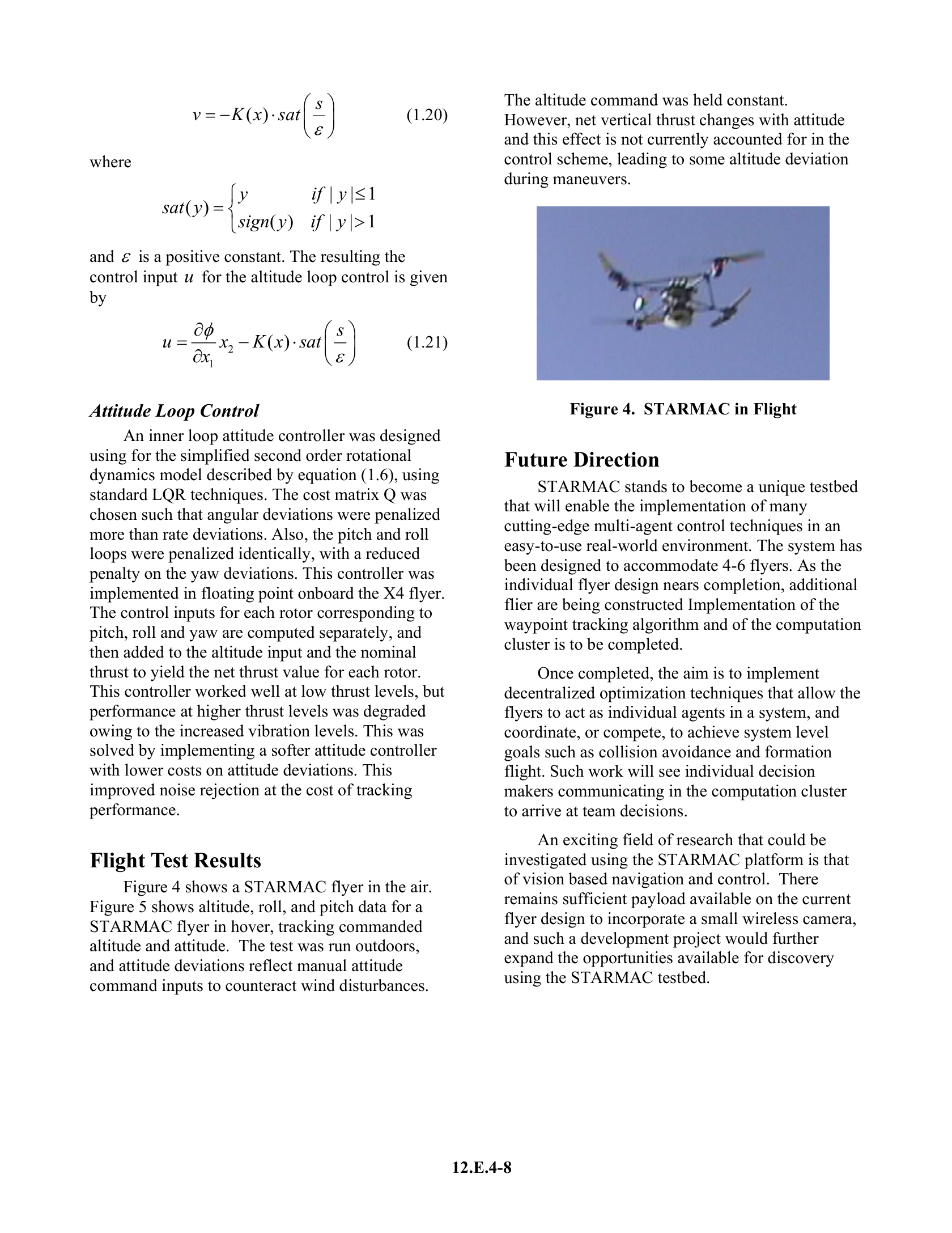
Read as the examiner and the patent read it, automatic control by programmable electronics, which Louvel’s sensor loop meets. Under the owner’s narrow reading, closed-loop attitude and position control on board, the chart rests on STARMAC’s on-board loops and on Wobben.
A claim-wide point that limitations 1a and 1j depend on. These pages show the STARMAC loops the narrow reading falls back on.
Claim chart · Claim construction
R10 · Original p. 470 R10-DASC · Printed p. 12.E.4-8
Claim-wide point W2 · B 80
The reason to fit Louvel’s quadrotor with the coaxial pair in which each rotor has its own speed-controlled electric motor: the art states it (torque cancelled within the pair, flight on one motor, more lift, more efficiency), and a 2004 four-unit craft took the step.
Counted once for the chart. The owner has a colourable answer: Xing’s remark that a multirotor’s balance is hard to control, and hindsight.
Claim chart · Combination rationale
R3 · Publication page 2 R5 · Original p. 19